Custom Software vs. SaaS: Which Costs Less Over Three Years?
Custom software vs. SaaS compared over three years: subscriptions, per-seat fees, and lock-in against a build you own. When each option actually wins.
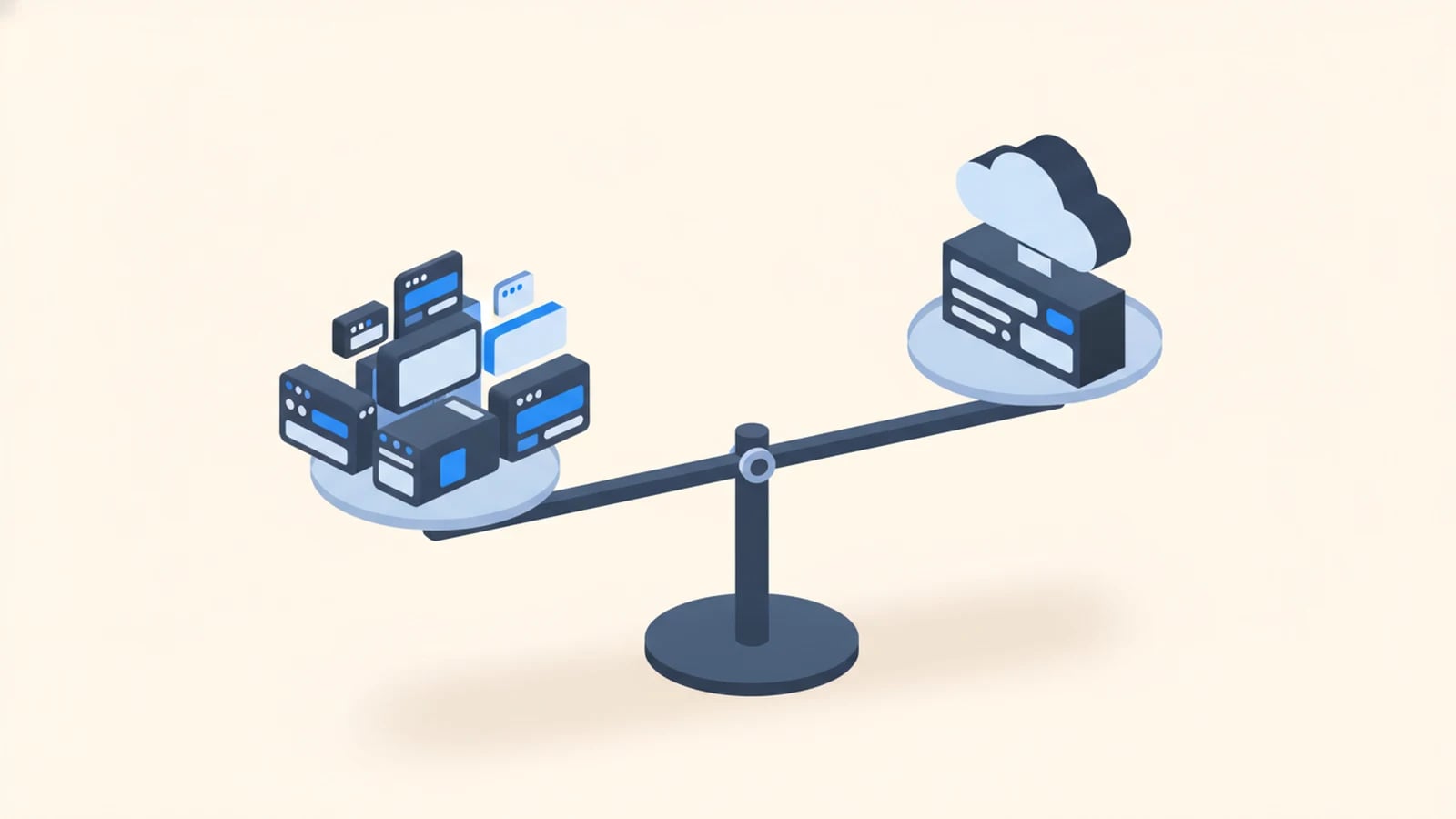
Custom software costs more on day one and less over its life. SaaS costs almost nothing to start and keeps charging every month you use it. Which one wins depends entirely on the horizon you measure: compare month to month and SaaS looks unbeatable; compare across three years, at your real headcount, and the answer often flips.
That flip is the whole decision, and most build-versus-buy arguments get it wrong by comparing the wrong two numbers. Our guide to custom software development covers the build side in full. Here the job is narrower: put a subscription and a build next to each other, honestly, over the same span of years, and show where each one genuinely wins.
What You Actually Buy in Each Model
The two models sell different things, and the difference matters more than the price.
SaaS (software as a service) rents you access to a standardized product. You pay per user, per month, and in exchange the vendor hosts it, updates it, and fixes it. You never own it, you can't change its core behavior, and your data lives in their system on their terms. It's fast to start and requires no engineering.
Custom software is built to your specification and delivered as code you own. There's an upfront cost and a build window measured in weeks. After that, there are no per-seat fees, no vendor roadmap imposed on you, and no ceiling on what it can do, because you can change anything. The tradeoff is ownership: the software is yours to run and maintain.
One rents standardized function. The other buys a specific asset. Comparing their prices without naming that difference is how the comparison goes wrong.
The Comparison That Matters Is Total Cost of Ownership
Price tags mislead because they measure different moments. The subscription shows a monthly figure; the build shows a one-time figure. Set side by side, the monthly number always looks smaller, which is exactly why it's the wrong comparison.
The honest metric is total cost of ownership (TCO): the full cost of each option across the same number of years. The research firm Gartner popularized the term back in 1987 to make a simple point that still holds: the purchase price of a system is a fraction of what it costs to run. For SaaS, TCO is mostly the recurring fee, multiplied by users, multiplied by years, plus add-ons and integrations. For custom, TCO is the build cost plus hosting and occasional maintenance. Pick a horizon, total both, then compare. Three years is a fair floor for software that will still exist in three years.
A Worked Example: Thirty Users Over Three Years
Numbers make it concrete. Take a mid-sized ops team that needs a tool covering a process specific to how they work.
On the SaaS side, a capable business tool runs around fifty dollars per user per month. At ten users, that's eighteen thousand dollars over three years, for access alone. Scale to thirty users, add the analytics tier the team needs and one paid integration to the ERP, and the three-year total climbs well past that, before a single renewal price increase. The meter never stops, and it rises every time you hire.
On the custom side, a tool of comparable scope lands in our Custom Web App range of €4,000–12,000, once, plus an optional care plan at €100–300 per month for hosting and small changes. You own the result. There are no per-seat fees, so growing from thirty users to sixty changes nothing about the cost.
The shapes are what matter. The subscription is a flat line that ratchets upward with headcount and renewals. The build is a step up front, then nearly flat. Early on, SaaS is cheaper. At some point the two lines cross, and after that the owned tool is cheaper every remaining month, while doing exactly what the process needs. Only a TCO view over years, not months, shows you where that crossing point sits for your own numbers. The full payback math is in our guide to calculate ROI on custom software.
Where SaaS Wins
Renting is the right call more often than build-happy advice admits.
SaaS wins for commodity processes: payroll, accounting, email, video calls, help-desk ticketing. These work the same at almost every company, the vendors have refined them over years, and you gain nothing by owning a bespoke version. It also wins when you need something running tomorrow, when the vendor's ecosystem is the actual value (an app marketplace, a payment network, a certified compliance regime), and when the process is still changing week to week and you're not yet sure what to build. In all of those, subscribe and move on.
Where Custom Wins
Building wins where a subscription quietly costs you, in money or in fit.
Custom pays off when per-seat fees at scale outrun a one-time build, when the process is your competitive edge and a generic tool caps you at your competitors' workflow, when no off-the-shelf product fits without a maintained spreadsheet bolted to its side, and when structural requirements (multiple languages, unusual integrations, data-residency rules, code ownership) rule out renting. The demand is real and growing: Grand View Research valued the custom software development market at $45.4 billion in 2025 and projects 18.8% annual growth from 2026 to 2033, with small and mid-sized firms the fastest-growing segment.
The hidden line item that tips many of these cases is the labor spent working around a not-quite-right tool, which we break down in the hidden costs of off-the-shelf software.
The Hybrid Most Companies Actually Land On
The real answer is rarely all-or-nothing. Most companies should rent the commodity and build the difference.
Subscribe to payroll, accounting, and email. Build the quoting engine, the dispatch board, or the client portal that encodes how you win business. A stack of well-fitting subscriptions for the generic work, plus one owned tool for the process that sets you apart, beats forcing everything into one model. The skill is drawing the line in the right place: commodity on one side, competitive edge on the other. Get that line right and you spend on ownership only where ownership pays.
Frequently Asked Questions About Custom Software vs. SaaS
Is custom software cheaper than SaaS?
Not on day one, and often yes over three years. SaaS wins early because the monthly fee is small. As per-seat costs grow with headcount and add-ons stack up, the subscription's running total can pass the one-time cost of an owned build. The horizon decides the answer.
When should I choose SaaS over custom software?
Choose SaaS for commodity processes every company runs the same way, when you need something live immediately, when the vendor's ecosystem is the point, or when the process is still changing and you don't yet know what to build. Renting a mature product beats building one you don't need.
When is custom software the better choice than SaaS?
When per-seat fees at scale exceed a one-time build, when the process is your competitive edge, when no off-the-shelf tool fits without workarounds, or when you have structural requirements like multiple languages, unusual integrations, or code ownership. Those are the cases a subscription can't serve cleanly.
How do I calculate the total cost of ownership for each?
Pick a horizon, usually three years. For SaaS, total the per-seat fee at your expected headcount, plus add-ons and integration tiers. For custom, total the build cost plus hosting and maintenance. Compare the two totals over the same years, not month to month.
Can I use both SaaS and custom software together?
Yes, and most companies should. Rent commodity processes like payroll and email, and build the one or two processes that set you apart. A mix of well-fitting subscriptions plus a single owned tool for your competitive edge usually beats forcing everything into one model.
Find Your Crossing Point
Tell us the process, the subscription you're weighing, and how many people will use it in three years. We'll help you total both sides honestly, and if a build comes out ahead, reply with a fixed scope, a fixed price, and a delivery date in weeks.
Keep reading
Need software that speaks every market from day one?
Tell us what you need built. We reply with a fixed scope, a fixed price, and a delivery date measured in weeks.