The Custom Software Development Process, Step by Step
The custom software development process in five stages: scoping, design, build, acceptance testing, and handover. What happens at each, and what to verify.
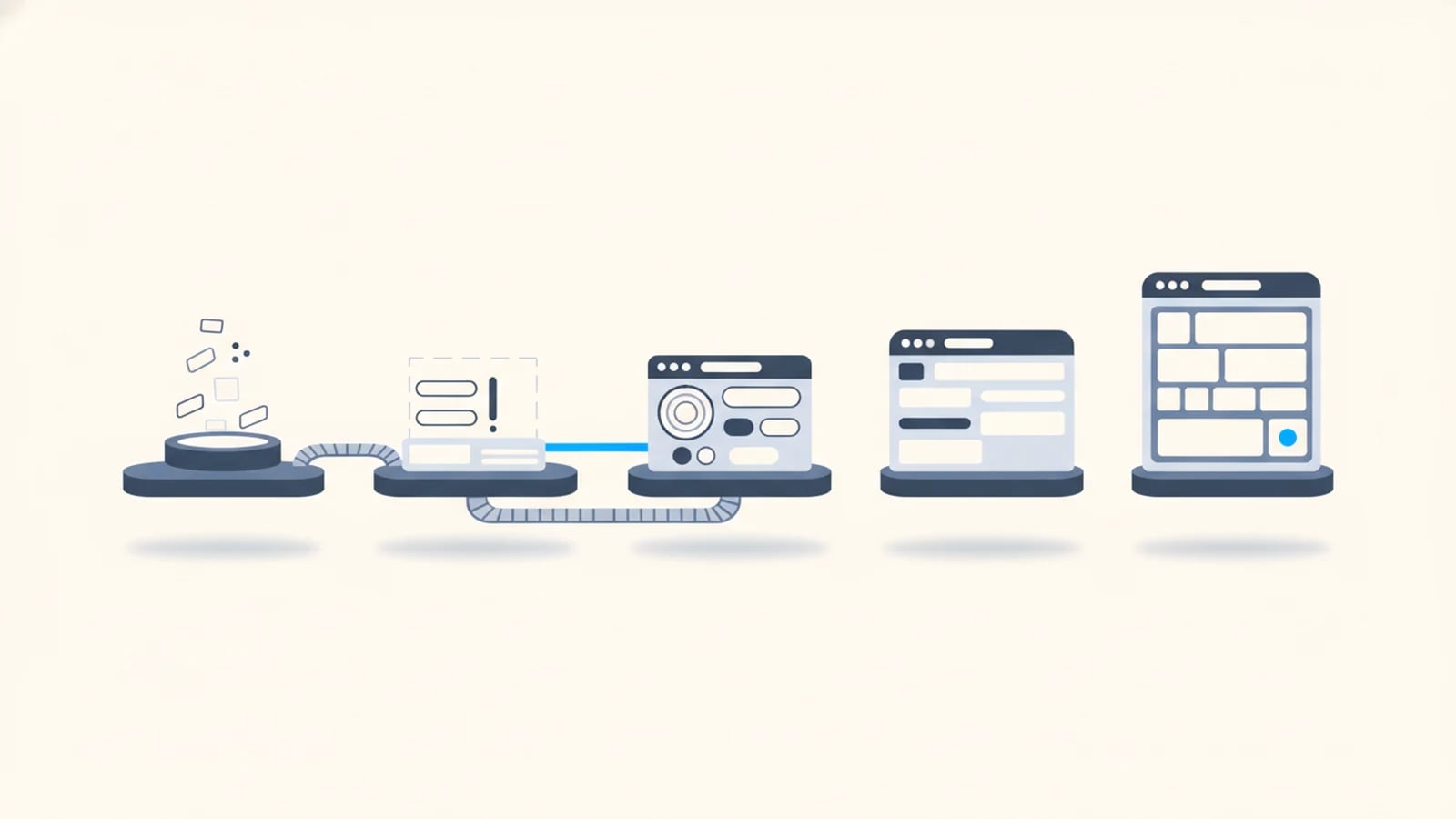
The custom software development process is the path a project takes from a rough idea to running software you own, and it always moves through five stages: scoping, design, build, acceptance testing, and handover. Vendors rename them constantly. The arc underneath is the same one every time, and knowing it lets you tell a serious process from an open-ended one before you sign.
Written for the person commissioning the software, not the person writing it. Our guide to custom software development covers cost, timelines, and the build-or-buy decision. What follows is the mechanics: what happens at each stage, and what you should be able to verify before it moves on.
The Five Stages Every Build Goes Through
Under any methodology, the work follows the software development life cycle (SDLC): the sequence from requirements to a running, maintained system. Agile teams loop through the stages in short cycles. A fixed-scope build runs them once, deliberately. Either way they arrive in the same order, and skipping one is where projects go wrong.
That is not a new observation. The Standish Group's original CHAOS Report (1994) found that 52.7% of software projects would cost 189% of their original estimates, with incomplete and changing requirements near the top of the causes respondents named. Thirty years on, the pattern holds: building starts before scoping finishes. The stages below are ordered to prevent that.
Stage 1: Requirements and Scoping
Your process becomes a written specification here. Screens, user roles, business rules, integrations, acceptance criteria, all in plain language you can read and check. Everything downstream rests on it.
A vague scope ("build us a portal") is how hourly projects balloon, because every unstated assumption turns into a change request three months in. A precise scope names what the software does and what it deliberately doesn't. Your job as the buyer is to catch anything missing while it's still a sentence on a page rather than a feature to rebuild.
Insist the scope carry acceptance criteria: the specific conditions the finished software has to meet. Those become the test in stage four. Writing them now is what makes that stage short.
A good sign: the vendor asks uncomfortable, specific questions about edge cases. What happens to a partial payment, a canceled order, a user who holds two roles. A bad sign: they nod along and promise to "figure it out during development."
Stage 2: Design and Architecture
With the what settled, the how gets decided: the data model, the integration approach, the security model, and, for anything that will cross a border, the internationalization plan.
These choices are mostly invisible to you and expensive to change afterwards, which is why they land before any feature gets built. The data model sets what the software can represent at all. The integration approach sets how cleanly it talks to your ERP, your payment provider, your carriers. The security model sets who can see and do what.
Multiple languages or currencies belong here too, built into the foundation now or retrofitted painfully in year two. You won't review most of this in detail. You should know it was decided on purpose, and be able to ask why.
Stage 3: Build
The software actually gets written. For us that means AI-assisted development: engineers direct AI coding tools to generate the software, then review, test, and harden every part of the output.
Insist on visibility. You should see working software while the build runs, not a black box that opens on launch day. Regular check-ins against the scope catch drift while correcting it is still cheap. A build that goes quiet for weeks and reappears finished is a build hiding a scope problem until fixing it costs money. How we run it, including how AI-written code gets reviewed before it reaches you, is on how we scope, build, and review.
Stage 4: Acceptance Testing
The software now gets checked against the acceptance criteria written in stage one. That is user acceptance testing (UAT): you, or your team, verifying the software does what the scope said, before it goes live.
Buyers underestimate this stage more than any other, and it protects them more than any other. Write stage one clearly and there is nothing to argue about here, because each criterion passes or it doesn't and there's a document to point at. Write it vaguely and the disagreements all arrive at once, at the worst possible moment.
Test real scenarios, not the happy path. The awkward order. The unusual customer. The data that doesn't fit the mold. Software that passes a demo can still fail a Tuesday, and finding that out now, with the vendor still on the hook, costs nothing.
Stage 5: Handover and Maintenance
The build ends with deployment, documentation, training, and, on a custom project, code ownership: the full source code and repository placed in your hands. That is what separates owning software from renting it.
A real handover means the code, the infrastructure configuration, and the notes a new developer would need to pick it up cold. Not a login to a running app.
After that, maintenance becomes a choice. Owned software still needs hosting, updates, and the occasional change, and those can come from a care plan with the original team, an in-house developer, or a different vendor entirely, because the code is yours. Ask before you start exactly what arrives at handover. The answer tells you whether you're buying an asset or a leash.
How AI-Assisted Delivery Changes the Timeline, Not the Stages
AI-assisted development compressed the middle of all this without removing a single stage. The build phase that once ran months now runs weeks: a scoped workflow automation in two to three, a full web application in three to six, a multilingual platform in five to eight, measured from approved scope to production.
The discipline around the build didn't move. Scoping still comes first, because AI cannot guess a requirement you never stated. Acceptance testing still comes last, because generated code needs verifying like any other code. Handover still delivers code you own.
The typing got faster. The judgment, the architecture, and the accountability stayed human. A vendor using AI as a reason to skip scoping or skip testing isn't moving faster, only moving the risk onto you.
Frequently Asked Questions About the Software Development Process
What are the stages of the custom software development process?
Five, in order: requirements and scoping, design and architecture, build, acceptance testing, and handover with maintenance. Together they form the software development life cycle. The names vary between vendors and methodologies, but the sequence is consistent, and skipping a stage is where projects fail.
What is the software development life cycle (SDLC)?
The software development life cycle is the full sequence a build follows from requirements to a running, maintained system. Agile methods repeat the stages in short cycles; fixed-scope projects run them once. Either way it covers scoping, design, building, testing, deployment, and maintenance.
Which stage of software development is most important?
Requirements and scoping. A vague scope is one of the main causes of overruns and disputes, because every unstated assumption becomes a costly change later. Time spent making the scope precise, with clear acceptance criteria, pays back at every later stage, especially during testing.
What is user acceptance testing (UAT)?
User acceptance testing is the stage where you, the buyer, verify the finished software against the acceptance criteria agreed during scoping, before it goes live. Test real scenarios, including the awkward edge cases, not just the demo path. Clear criteria written early make this stage fast and argument-free.
Does AI-assisted development change the process?
It compresses the build phase from months to weeks, but the stages stay the same. Scoping still comes first, acceptance testing still comes last, and code ownership is still delivered at handover. AI speeds the writing; human judgment, architecture, and review remain. Skipping a stage only moves the risk onto you.
Start With a Scope You Can Read
Tell us the process you want built, and we'll turn it into a written scope with acceptance criteria you approve before any code is written, then a fixed price and a delivery date measured in weeks. If a build isn't the right call, we'll say so, as we cover in when to build custom software.
Keep reading
Need software that speaks every market from day one?
Tell us what you need built. We reply with a fixed scope, a fixed price, and a delivery date measured in weeks.