Human Review vs. Fully AI-Generated Code: Why the Difference Is the Product
Date Published
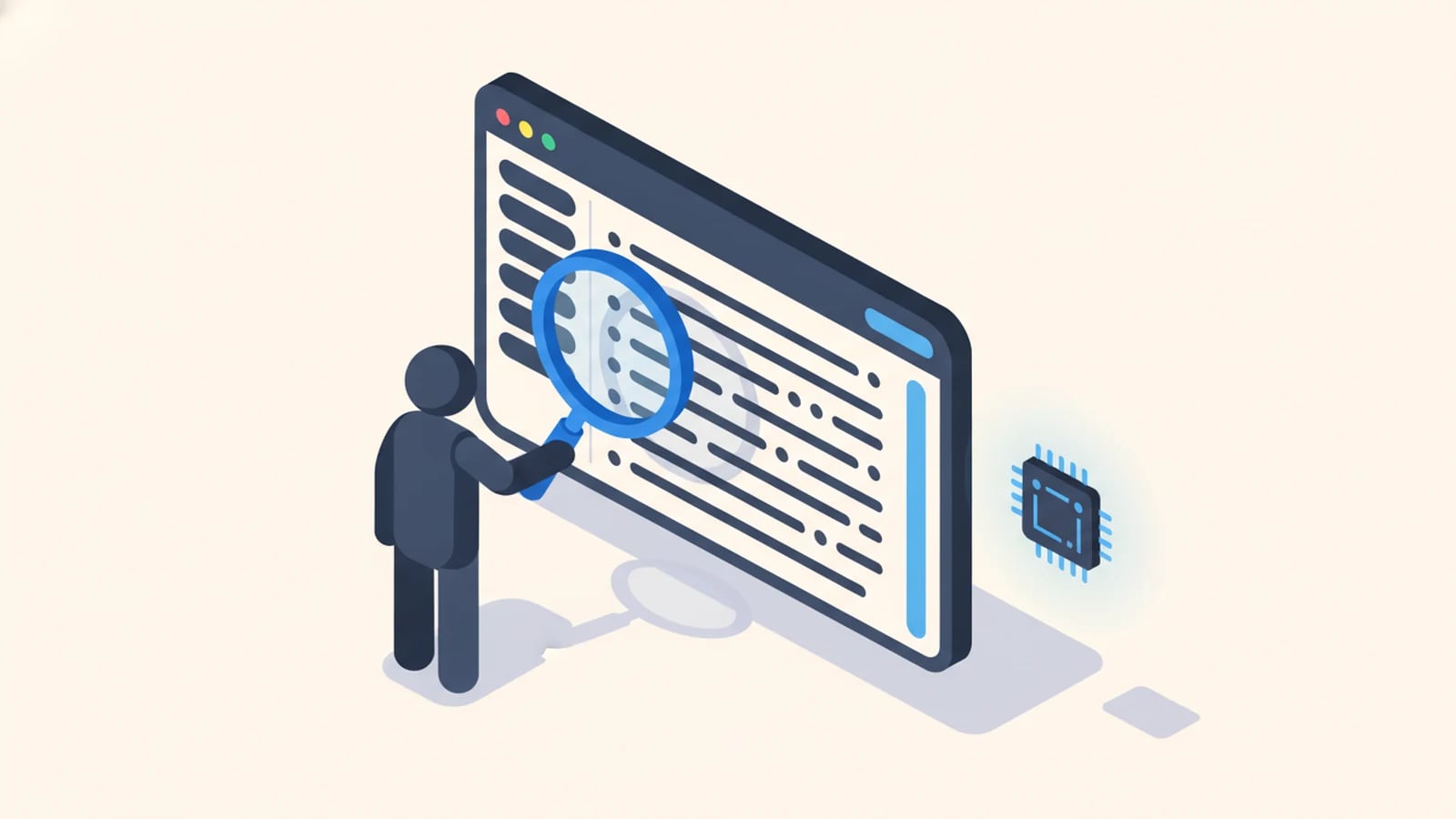
Fully AI-generated code and reviewed AI-generated code can come from the same model on the same prompt, and still be two different products. The reviewed version is software you can run a business on. The unreviewed version is a demo that has not failed yet. The review is the difference.
Every efficient team now writes code with AI, so "do you use AI?" stopped telling you anything. A narrower question does the work: who reads the code before it ships, and what do they catch? For the practice the review sits on top of, start with vibe coding and AI-assisted development.
The Same Code, Two Different Products
An AI model produces plausible-looking code. Plausible is a weaker claim than correct, or safe, or maintainable, and the model bears no consequence for the distance between them. It answered the prompt. Whether the answer holds up on a Tuesday in March is somebody else's problem, and in a vibe-coded project that somebody is nobody.
Human review closes the gap. A senior engineer reads what the model wrote, questions it, corrects it, and only then lets it merge. The generation step is unchanged; the code has simply gone from an educated guess to a reviewed decision, which is the point at which a business can depend on it.
Google generates 75% of its new code with AI and still puts engineers in front of it before acceptance (The Decoder, 2026). The organizations best at AI coding turn out to be the ones most disciplined about reading its output.
What a Human Reviewer Actually Catches
Four specific failure modes get stopped in review. The same four ship straight to production when nobody reads the code. Our guide on whether AI-generated code is safe covers the risk list in full.
Security holes the model copied from its training data. Large language models learned from public code, mistakes included. Veracode's 2025 GenAI Code Security Report found that AI-generated code introduced a known security flaw in 45% of its test tasks, from injection-prone database queries to cross-site scripting and weak cryptography. A reviewer catches the exposed key and the unvalidated form field in the diff, before they become an incident.
Dependencies that do not exist. Models sometimes import software packages they invented. A 2025 USENIX Security study measured roughly 5.2% of packages suggested by commercial models as hallucinated, rising to about 21.7% for open-source models. Attackers register real malware under those invented names, so the next person who "fixes" the failing import installs it. A reviewer, backed by a dependency scan, stops the fictional import from ever reaching the build.
Logic that is wrong without crashing. A discount that rounds the wrong way on one currency, a date filter that drops the last day of the month, a permissions check that passes every role except the untested one: these run clean for weeks and surface only when a customer notices the total is off. A reviewer who understands the business reads for intent, not just for whether it compiles.
Code that works today and cannot be changed tomorrow. Models duplicate logic instead of reusing it, because each prompt is answered fresh with no memory of the codebase. A reviewer folds the duplication back together and keeps the architecture coherent, which is what stops a small change six months out from breaking something unrelated.
Why Automated Tools Are Not Enough on Their Own
Scanners and linters cannot replace the human, and treating them as a substitute is its own failure mode.
Automated dependency scanning earns its place, and it runs on every serious build: a package carrying a known advisory should break the build rather than reach production. What a scanner does is check known patterns against known databases. It has no view on whether your discount logic rounds the wrong way, whether a permissions boundary sits in the wrong place, or whether the model solved the wrong problem correctly. Those need judgment, which is the one thing neither a model nor a linter has.
So the layers stack rather than compete. Tools take the mechanical failures at machine speed and scale, humans take the ones that need an understanding of the business the software serves, and pulling the human out leaves the mechanical checks passing while the software quietly does the wrong thing. Our full pipeline is described in how we scope, build, and review, and the tooling side in detail on how we secure every build.
Review Is Also Where Accountability Lives
Review produces a second thing no tool can: an accountable human who understands your software.
Once an engineer has read every line before it merged, somebody can explain how the system works, why it was built that way, and what will break if you change it. That person hands the codebase over cleanly, answers a security questionnaire honestly, and fixes the next bug without a blind negotiation with the model. A vibe-coded app has nobody in that chair, which is most of why it costs so much to own. CISQ put the cost of poor software quality in the US at $2.41 trillion, on top of an estimated $1.52 trillion in accumulated technical debt (CISQ, 2022).
Which is why review and code ownership travel together. Handing over full ownership is easy for a vendor who has read every line and can stand behind it, and awkward for one who has shipped unread output and would rather you stayed dependent, whatever the contract says.
What to Ask a Vendor About Review
Every AI development shop calls its code reviewed. Few can describe the review in terms you can check. Three questions do it.
Ask who reads the code. You want a named role, a senior engineer, not "the team" or "our process." Ask when they read it: before every merge, not "eventually" or "if something looks off." Then ask what happens when a check fails, because a real pipeline blocks the release and a decorative one logs a warning and ships anyway.
Plain sentences in reply mean there is a review step. Adjectives in reply usually mean there isn't, and that one gap outweighs almost everything else on the pitch.
Frequently Asked Questions
Who should review AI-generated code?
A senior engineer who can read the code, understand the business it serves, and own the architecture decisions. Not the model that wrote it, not a junior signing off unread, and not an automated scanner alone. Review is a judgment task, so it needs qualified human judgment.
Can automated tools replace human code review?
No. Dependency scanners and linters catch mechanical, known-pattern problems fast, and they belong on every build. They cannot tell that the code solved the wrong problem correctly or that a permissions boundary is misplaced. Those require a human who understands what the software is for.
What does a human reviewer catch that AI misses?
Security holes the model copied from training data, imports of packages that do not exist, logic that is wrong without crashing, and duplicated code that makes future changes dangerous. All four ship straight to production when nobody reads the output before release.
Does reviewing AI-generated code slow the project down?
Barely, and it saves far more later. The AI still compresses the writing, so a reviewed build ships in weeks, not months. Skipping review only looks faster until the first incident, when the unreviewed shortcut becomes an emergency instead of a line comment.
Is reviewed AI code as safe as human-written code?
Yes, for the same reason human-written code is safe: someone qualified read, tested, and secured it. Safety comes from the review and the testing, not from whether a person or a model produced the first draft.
How does Globaprom review AI-generated code?
A senior engineer reads every line before it merges, dependency scanning runs on every build, and a test suite proves the behavior before handover. Our AI-assisted development services put that process in writing, with named reviewers you can ask about directly.
The Review Is the Thing You Are Buying
Speed comes from the AI. Trust comes from the review. Buy only the first and you have a demo that has not failed yet; buy both and you have software that carries a business. Tell us what you need built and we will show you exactly who reads your code and when, alongside a fixed scope, a fixed price, and a delivery date.